Optimization
Optimization problems ask: What is the maximum or minimum value of something? Derivatives help us find these extreme values by locating where the slope is zero.
The Optimization Process
Five steps to solve any optimization problem
Illustration: optimization-box
Critical Points
Critical Point
A point where f'(x) = 0 or f'(x) is undefined. Maxima and minima can only occur at critical points.
Optimization Strategy
1. Define what you're optimizing (max or min of what?)
2. Write a formula for that quantity
3. Take the derivative and set it equal to zero
4. Solve for critical points
5. Check if it's a max or min (second derivative test)
Box Optimization
Hard
Find the dimensions of a box with square base and volume 32 ft³ that minimizes surface area.
1
Define variables
Let x = side of base, h = height
2
Constraints
Volume: x²h = 32, so h = 32/x²
3
Surface area formula
S = 2x² + 4xh = 2x² + 4x(32/x²) = 2x² + 128/x
4
Differentiate
dS/dx = 4x - 128/x²
5
Set to zero and solve
4x - 128/x² = 0
4x³ = 128
x³ = 32
x = 2∛4 ≈ 3.17 ft
6
Find h
h = 32/x² = 32/(2∛4)² = 2∛4 ft
Answer:
Base ≈ 3.17 ft × 3.17 ft, height ≈ 3.17 ft (a cube!)
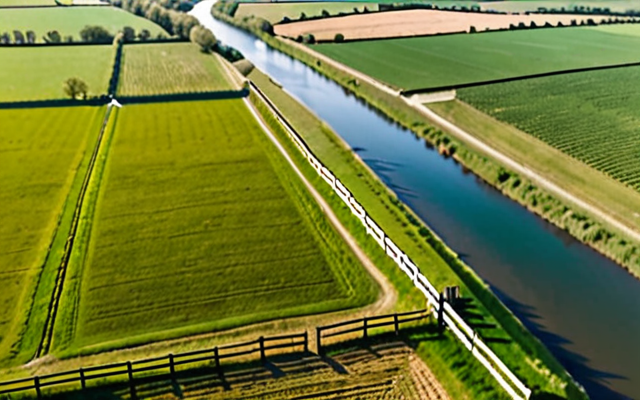
Real-World Application: Fencing a Field
Classic optimization: maximize the area of a rectangular field against a river (no fence needed on river side)
Practice
1. Find the maximum value of f(x) = -x² + 4x + 1
f'(x) = -2x + 4 = 0 → x = 2. f(2) = -4 + 8 + 1 = 5
Key Takeaways
To optimize: set derivative = 0, solve for critical points
Use constraints to reduce to one variable
Check endpoints and critical points for max/min
Second derivative test: f''(x) > 0 → minimum, f''(x) < 0 → maximum